
Fabric Success Starts with Well-Architected Principles

Fabric Success Starts with Well-Architected Principles
Created on 2026-05-17 14:30
Published on 2026-05-18 11:32
For me, practicing a Well Architected Framework (WAF) means designing cloud systems that do more than meet the immediate scope of an RFP. The goal is to build cloud platforms that scale, survive, and consistently deliver business value.
In 2023, I was first introduced to the Well-Architected Framework (WAF) while preparing for the IASA CITA-Professional (CITA-P) certification. A university friend—who at the time was working as a software engineer at AWS — pointed me toward the Security and Operational Excellence principles behind AWS CloudFormation and Infrastructure as Code practices, concepts AWS had been developing since 2011.
AWS later formalized these ideas in its first public Well-Architected whitepaper in 2015, built around four foundational pillars: Security, Reliability, Performance Efficiency, and Cost Optimization.
Microsoft formally adopted a similar approach with the Microsoft Azure Well‑Architected Framework in July 2020. In May 2020, Google Cloud published its equivalent: the Google Cloud Architecture Framework.
Today, the three major cloud providers— Amazon Web Services (AWS) , Microsoft Azure and Google Cloud Platform (GCP) —are aligned on the foundational pillars of infrastructure design. That alignment is a major win for the industry: it gives organizations a consistent, platform‑agnostic definition of what “good architecture” looks like.
Security: Protecting data, systems, and assets through layered defense.
Reliability: Preventing and quickly recovering from infrastructure or service failures.
Performance Efficiency: Using IT resources efficiently to meet system requirements.
Cost Optimization: Avoiding unnecessary costs and maximizing return on investment.
Operational Excellence: Running and monitoring systems to deliver business value.
Sustainability: Minimizing the environmental impacts of running cloud workloads.
The main remaining difference is how providers treat environmental impact. AWS and GCP treat Sustainability as a standalone sixth pillar, while Microsoft treats sustainability as a cross‑cutting lens that embeds green software principles across all pillars.
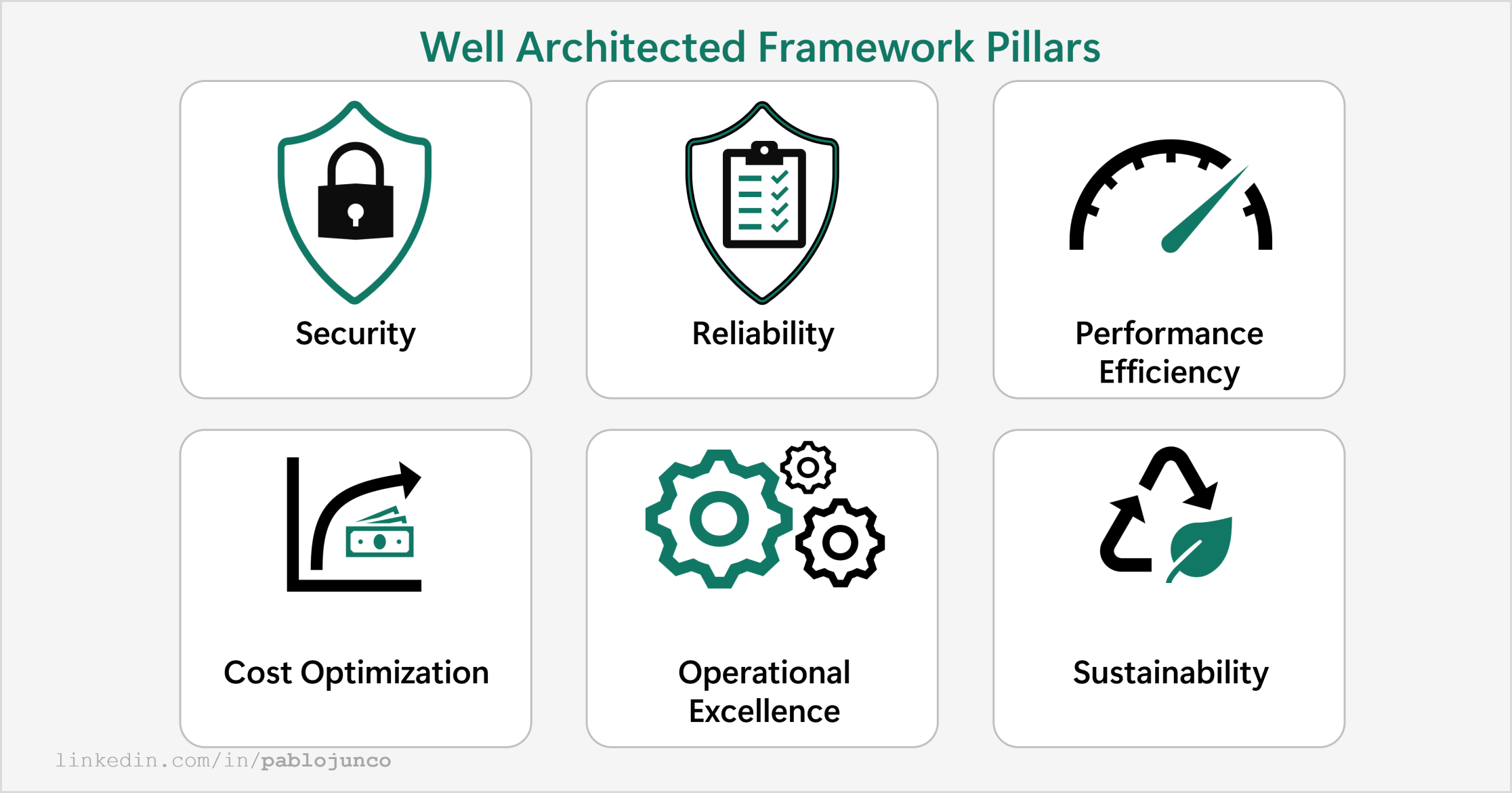
In short, a Well Architected Framework forces teams to make intentional, measurable, and repeatable architecture decisions—reducing risk, improving performance, and accelerating business outcomes.
1) Microsoft Fabric and the Well Architected Framework
If you are a CIO, CDO, CTO, or business decision maker using Microsoft Fabric, WAF should be part of your adoption strategy. Microsoft Fabric is a unified data and analytics platform that brings ingestion, transformation, real‑time processing, warehousing, and BI onto a single foundation. That unification is powerful, but it also increases the blast radius of every architectural decision compared with siloed analytics stacks.
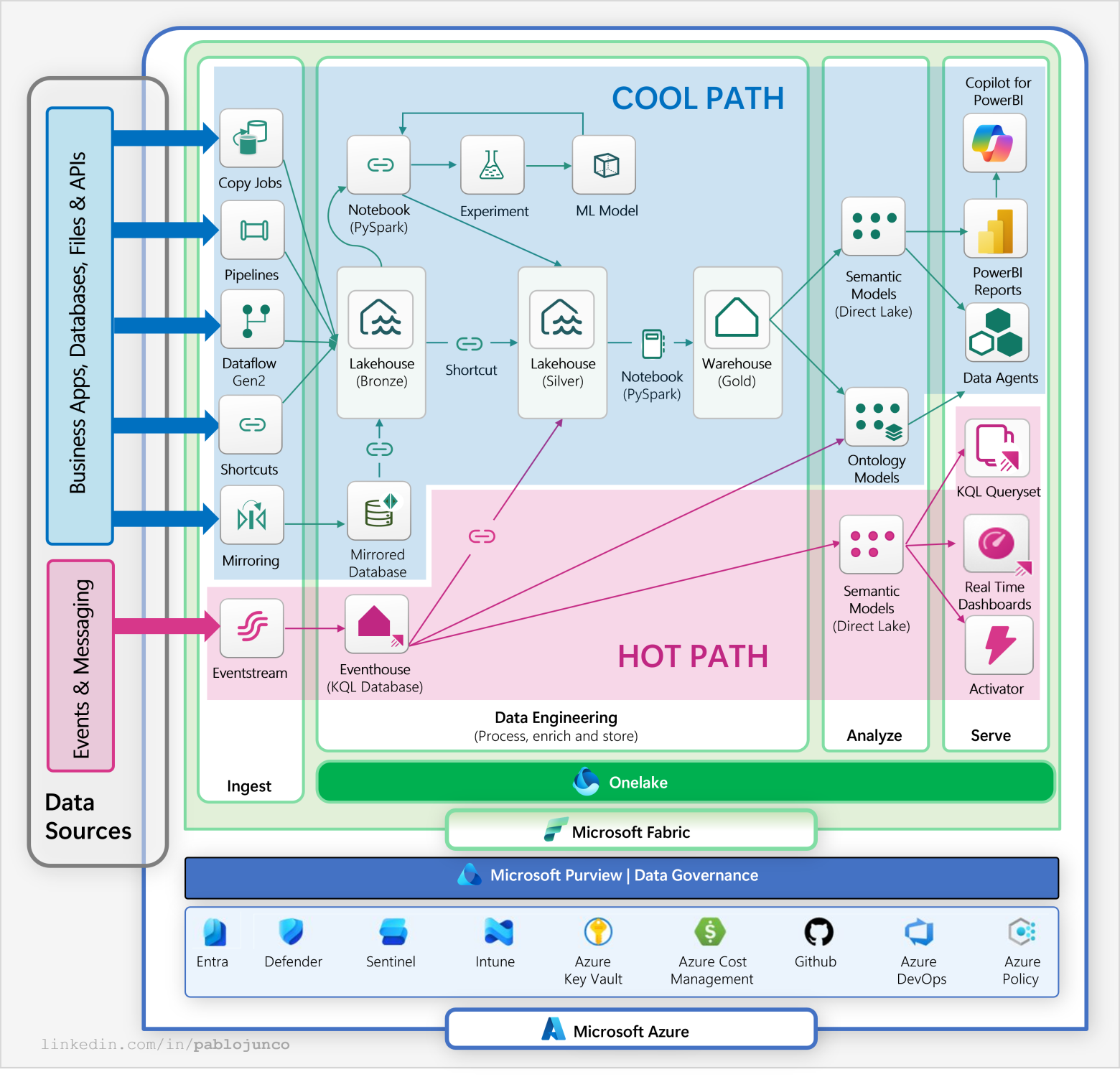
Because Fabric consolidates multiple compute engines and workloads, organizations must ensure their architecture is reliable, secure, performant, cost efficient, and operationally mature—and WAF provides the structure to do exactly that.
2) Why WAF matters for Microsoft Fabric
Unified platform = unified risk — Shared capacity means Spark jobs, pipelines, SQL queries, and Power BI refreshes draw from the same compute pool. Without intentional design, one workload can degrade all others. The Reliability and Performance Efficiency pillars help ensure predictable performance across workloads.
Governance must scale with flexibility — Fabric makes it easy to create Lakehouses, Warehouses, and semantic models. That agility accelerates innovation but raises risks: uncontrolled data growth, inconsistent security boundaries, unclear ownership, and shadow analytics. The Security pillar provides guardrails to protect data, identities, and collaboration at scale.
Cost efficiency requires architectural discipline — Capacity‑based compute ties cost directly to design choices: inefficient pipelines, poorly designed models, unnecessary refreshes, and oversized capacities drive spend. The Cost Optimization pillar aligns spending with business value.
Operational excellence turns pilots into production — Rapid development is possible, but production‑grade analytics require deployment pipelines, version control, automated testing, progressive rollouts, and proactive monitoring. The Operational Excellence pillar ensures teams can operate Fabric workloads with confidence.
3) How WAF strengthens Fabric design
The Well-Architected Framework (WAF) strengthens Microsoft Fabric design by transforming architectural principles into repeatable and measurable engineering practices. It helps ensure that every Fabric workload—whether focused on data ingestion, transformation, real-time analytics, machine learning, or business intelligence (BI)—operates securely, reliably, and efficiently across shared capacity environments.
A practical way to visualize this alignment is through the six core WAF pillars and how they map to Fabric capabilities:
Security — Enforces governance, identity management, data protection, RBAC, Purview integration, and compliance controls across the unified data estate.
Reliability — Ensures resilient data pipelines, recoverability, workload isolation, and predictable execution across Lakehouses, Warehouses, Dataflows, and Real-Time Analytics.
Performance Efficiency — Guides architectural decisions for scalability, query optimization, partitioning strategies, Direct Lake adoption, and workload balancing.
Cost Optimization — Helps organizations maximize Fabric capacity utilization, optimize SKU sizing, reduce redundant data movement, and improve workload efficiency.
Operational Excellence — Promotes automation, monitoring, CI/CD, observability, and standardized deployment practices to improve operational consistency.
Sustainability — Encourages efficient resource consumption, reduced compute waste, and optimized data lifecycle management to lower environmental impact.
WAF principles also translate directly into practical Fabric design decisions:
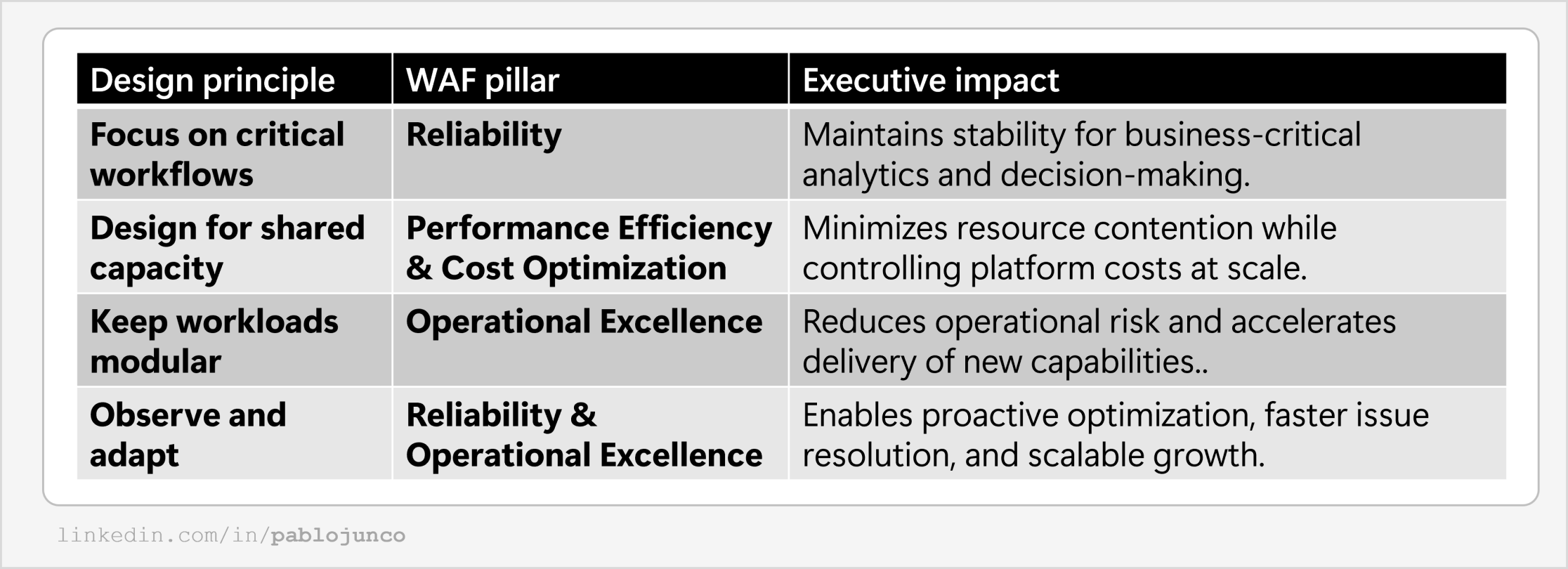
In practice, WAF acts as the operating model for successful Fabric adoption. It provides a structured approach to evaluating architectural decisions across reliability, security, cost, performance, and operations. As a result, organizations can transform Microsoft Fabric from a collection of analytics services into a governed, scalable, AI-ready data platform that consistently delivers measurable business value.
Below are the core outcomes WAF delivers, each with a short description and a concrete technical example you can apply in Microsoft Fabric.
3.1) Reduce risk
Lower the likelihood and impact of failures, data breaches, and compliance gaps by making architecture decisions explicit and testable.
Technical example: Implement automated deployment pipelines for Fabric artifacts (Lakehouses, Warehouses, semantic models) with gated CI/CD checks and integration tests. Combine these pipelines with environment‑specific capacity limits and automated rollback policies so a faulty pipeline or schema change cannot propagate to production.
3.2) Control cost
Align spending with business value by measuring consumption, enforcing budgets, and optimizing resource allocation.
Technical example: Use Fabric Capacity Metrics Apps to track capacity usage per workspace and workload, set alerts for anomalous consumption, and implement autoscaling policies plus scheduled capacity reservations for predictable ETL windows to avoid overprovisioning.
Recommended reading:
3.3) Improve performance
Description: Ensure predictable, efficient execution of analytics workloads so SLAs are met and user experience is consistent.
Technical example: Apply workload isolation by tagging and routing Spark jobs, SQL queries, and Power BI refreshes to dedicated compute pools; use query performance insights and materialized views in Fabric to reduce repeated compute and speed up interactive queries.
3.4) Strengthen governance
Make data discoverable, trusted, and protected through access controls, lineage, and auditability—critical for compliance and safe AI use.
Technical examples:
Enforce item/row/column level security in Fabric, enable built‑in lineage and query auditing.
Integrate with Microsoft Purview for centralized classification, policy enforcement, and cross‑platform data cataloging so analysts only use verified, compliant datasets.
I do recommend reading: Governing AI Responsibly in Modern Analytics Platforms
3.5) Accelerate time to value
Use Fabric’s AI capabilities to shorten development cycles, improve runtime performance, and enable agentic workflows that deliver business outcomes faster while preserving governance. Fabric accelerates both developer productivity and production performance by embedding AI into design, testing, optimization, and runtime assistance.
Technical examples:
AI‑assisted development and modeling — Use Fabric’s AI helpers to auto‑generate ETL pipelines, SQL queries, and semantic model suggestions from natural‑language prompts or sample data. This reduces manual coding, speeds prototyping, and produces repeatable templates teams can reuse.
Semantic Models as an AI-ready contract — Enrich semantic models with field descriptions, synonyms, natural‑language AI instructions, and verified Q&A pairs. Expose these artifacts to retrieval layers so LLMs and Data Agents consume compact, high‑quality context, improving answer accuracy and lowering token costs.
Data Agents and agentic platforms — Package semantic models, curated datasets, and execution policies into Data Agents that can be invoked by agentic platforms such as Microsoft Foundry and Microsoft 365 Copilot Studio. These agents perform end‑to‑end tasks (data discovery, transformation, and answer generation) while respecting capacity and performance constraints.
Note: You can read Agent-of-Agents: Why Al's Future Is Recursive to learn more about how to develop multi-agents using Microsoft Fabric as an unified source of knowledge.
Runtime optimization with AI — Use AI‑driven query advisors and workload classifiers to recommend materialized views, caching strategies, and compute routing. Automated recommendations can be applied as safe, reversible changes to improve latency and reduce repeated compute.
Governance for agentic workflows — Register Data Agents and their data sources in governance tooling (e.g., Agent 365 and Microsoft Purview) so every agent action is auditable, lineage is tracked, and access policies are enforced. This ensures agentic automation scales without sacrificing compliance or traceability.
3.6) Prepare for AI workloads
Design data and metadata so AI agents and models can consume high‑quality, well‑described inputs with minimal preprocessing and token cost.
Technical example: Use Fabric Semantic Models as an abstraction layer: add field descriptions, synonyms, natural‑language AI instructions, and verified question/answer pairs. Expose these enriched semantic artifacts to Data Agents and retrieval layers to improve answer accuracy and reduce prompt size (and token usage) when serving LLMs.
I do recommend to read the following article: The Real Magic Behind AI Accuracy Isn’t AI — It’s Your Data
4) Conclusion
For me, it’s clear: Microsoft Fabric is here to stay. The conversation is no longer about platform maturity or whether the product has reached enterprise readiness. Regardless of which workload engine you use—Data Factory, Data Engineering, Data Science, BI, RTI, or others—organizations still face critical architectural decisions around capacity planning, data design, governance, collaboration, security, and operations.
Microsoft Fabric is already running in production across thousands of organizations and is now used by more than 31,000 customers across industries. That level of adoption proves the platform is already delivering real business value today. But adoption alone is not enough. If you want solutions that scale, remain resilient, and consistently generate business outcomes, you need to pair Fabric with a repeatable architectural practice.
Today, as a Distinguished Certified Architect (CITA-D) by the Iasa Global (IASA) and a Principal Solution Engineer at Microsoft, I believe more than ever that the Well-Architected Framework (WAF) is that practice. WAF provides the language, metrics, governance principles, and technical patterns needed to transform Fabric’s capabilities into predictable outcomes. It helps organizations ensure that analytics and AI investments become durable strategic advantages—not isolated or short-lived projects.

